The Early Growth in USA and the rest of the World
The idea of Rotary spread throughout the United States. The San Francisco Club was founded in 1908.
In 1909 Clubs were formed in Oakland, Seattle, Los Angeles, New York and Boston.
In 1910 Clubs were formed in Tacoma, Minneapolis, St Paul rounding out the first 10 Clubs.
In August 1910, the first National convention was held in Chicago attracting 60 delegates including representatives of most of the then 16 Clubs in existence.
It was decided to form the National Association of Rotary Clubs, with Paul Harris as its founding President.
The Internalization of Rotary
The first non-USA club was formed in Winnipeg Manitoba in 1912. The organisation’s name was changed the same year to International Association of Rotary Clubs to reflect this milestone.
In 1911, Clubs were formed in Great Britain and Ireland in Dublin, Belfast, London and Manchester. But they were not Chartered into the world wide organisation until a few years later.
The first non English speaking club was formed in Havana Cuba in 1916.
The first Asian Club was formed in Manilla in 1919. The first African Club was formed in Johannesburg in 1921.
Rotary came to Australasia in 1921 also with Melbourne, Sydney, Wellington and Auckland all being chartered.
Rotary has since spread right around the world.
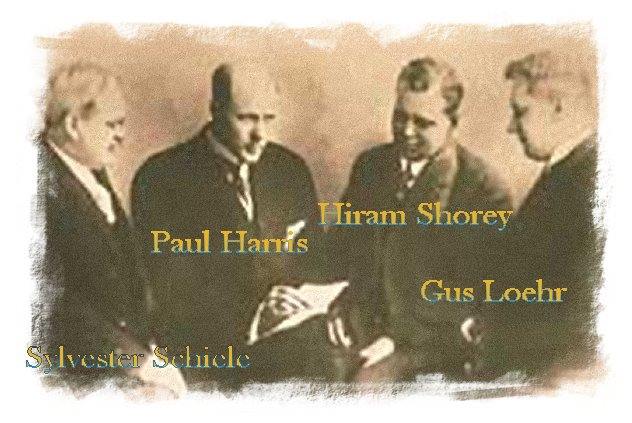
The first meeting of Rotary was four businessmen meeting on 23 February 1905 in Chicago. The catalyst was a 37 year old lawyer Paul P(ercy) Harris who had recently arrived in Chicago and was feeling a little lonely. His wish to recapture in a professional club the same friendly spirit he had felt in the small towns of his youth.
The others present were Silvester Schiele (coal merchant), Gus Loehr (mining engineer), and Hiram Shorey (tailor). The meeting was held in Loehr’s office at Room 711, Unity Building Chicago. The office was saved from demolition and reinstalled in Rotary’s HQ in Evanston.
Over the next few months other members were invited to join.
The original idea was to rotate the meetings among members’ offices (hence the name Rotary) but by the end of sixth, the membership was so large they had to change to meeting in hotels and restaurants..
The initial purposes of the meetings were that business leaders should meet periodically to enjoy fellowship and enlarge their circle of business and professional acquaintances. Within a year or two, a third purpose was developed which was “the enlightenment of its members with regard to, and the participation of its members in, public affairs or community welfare work, thereby making each member a better citizen.”
The Chicago Club’s first project was to erect city public toilets to improve sanitation in Chicago in 1907.
The first Club President was Silvester Schiele. In the third year Paul Harris was the Club President.
How should we describe the organization called "Rotary"?
There are so many characteristics of a Rotary club as well as the activities of 1.2 million Rotarians. There are the features of service, internationality, fellowship, classifications of each vocation, development of goodwill and world understanding, the emphasis of high ethical standards, concern for other people an many more descriptive qualities.
In 1976 the Rotary International Board of Directors was interested creating a concise definition of the fundamental aspects of Rotary. They turned to the three men who were then serving on Rotary's Public Relation Committee and requested that a one sentence definition of Rotary be prepared. After numerous drafts, the committee presented this definition, which has been used ever since in various Rotary publications:
"Rotary is an organization of business and professional persons united worldwide who provide humanitarian service, encourage high ethical standards in all vocations and help build goodwill and peace in the world.”
Those 31 words are worth remembering when someone asks, "What is a Rotary club?"